 Skip to content

How to Use a Blast Chiller (and Blast Chiller vs Blast Freezer Explained)
To use a blast chiller, portion your cooked food into shallow trays, load it within 30 minutes of it coming off the heat, push the probe into the thickest part, pick the chill cycle and let it pull the core down to 3°C or below. A blast chiller is not a bigger fridge. It moves a lot of cold air across hot food so it drops fast and safely, and that's the whole point of it.
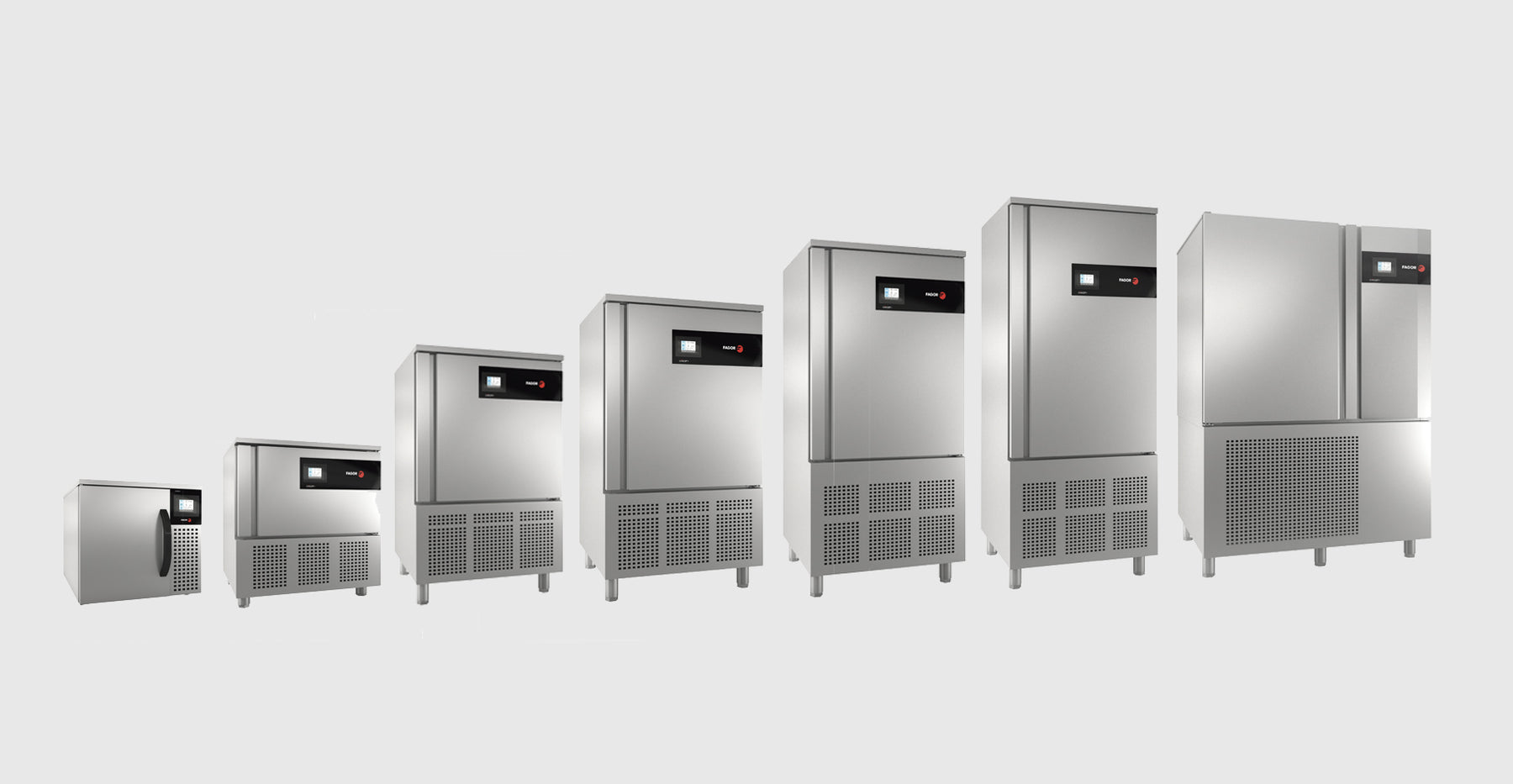
This guide covers how to run one properly, how long a cycle really takes, blast chiller vs blast freezer, how big a unit you need, what they cost and the questions Irish kitchens keep asking us. If you'd rather just see what's available, here's our full blast chiller and shock freezer range.
What is a blast chiller?
A blast chiller is a commercial unit built to take freshly cooked food from hot to fridge temperature far quicker than a normal fridge ever could. Powerful fans and a strong refrigeration system push very cold air across the food, and a core probe tells the machine when the middle of the food has hit target. Most also freeze, which is where the shock freezer name comes in (more on that below).
Why bother? Because the longer cooked food sits between warm and cold, the more time bacteria have to multiply. You also protect texture and yield. Food chilled fast stays moist and looks better on the plate the next day, and you can batch cook on a quiet afternoon instead of cooking to order every single time.
If you're still weighing one up against a standard fridge, our post on blast chiller vs standard fridge goes through it in detail.
How do you use a blast chiller step by step?
1. Start chilling quickly
The FSAI guidance on cook-chill systems says rapid chilling should start within 30 minutes of cooking finishing. Don't leave the pans sitting on the pass while service is going on.
2. Portion and spread it out
Shallow trays, thin layers, smaller portions. The same FSAI guidance suggests keeping loads to about 2.5kg and no more than 100mm thick so the chiller can do its job. A deep tray of stew is the classic way to fail a chill cycle, because the middle stays hot long after the edges are cold. Gastronorm pans or bakery trays are what these machines are designed around.
3. Let the air move
Leave gaps between trays and don't cover them tightly unless the food needs it. The air has to get across the food, not just sit around the outside of a stack. Don't pack it past its stated capacity either, because the cycle will run long and the unit will struggle.
4. Use the probe
Push the core probe into the thickest part of the food, away from the tray edge. Cycling by probe means the machine stops when the centre is cold, not when a timer says so. Use timed cycles only where the food can't take a probe.
5. Pick the right cycle
Most units give you a chill cycle and a freeze cycle. Chill is for food going into the fridge for the next day or two. Freeze is for food you're batching for longer storage. Some also have a gentler soft chill for delicate items such as mousses, where a hard chill can damage the surface. Check what your model offers on its spec sheet.
6. Move it on and label it
Once it's cold, get it into proper storage straight away. FSAI guidance is to store cook-chill food at 3°C or below. Label with the date and what it is. Food that has been thawed shouldn't be refrozen as an ingredient, so plan portions before you freeze.
7. Keep a record
The FSAI guidance expects temperature records for the chilling and storage stages, and a calibrated probe thermometer (accurate to within 0.5°C) for checking. Your HACCP plan should say how you do it. A quick log sheet beside the unit does the job, and some units let you download the data.
How long does a blast chiller take?
Manufacturers usually rate a chill cycle at taking food from about 70°C down to 3°C in around 90 minutes, and a freeze cycle from 70°C down to minus 18°C in around 240 minutes. Those are ratings under test conditions with a rated load. Your real time depends on how much food you put in, how thick it is and how hot it starts, so a half full unit with thin portions will beat a packed one every time.
The FSAI guidance for cook-chill systems sets the bar at 3°C or below within a maximum of 150 minutes, with chilling starting inside 30 minutes. So a unit that does 90 minutes with a normal load has comfortable room to spare. If your unit regularly takes longer than the food safety limit, the problem is usually overloading or deep trays, but it can also be a unit that's too small for your volume.
One exception worth knowing about is large whole joints of meat. The same guidance sets out a separate approach for them, but portioning is still the better way to go. If you cook big joints regularly, read the FSAI note fully before you build your procedure around it.
Blast chiller vs blast freezer: what's the difference?
A blast chiller brings food down to fridge temperature (3°C or below), ready to be used in the next few days. A blast freezer takes it all the way to minus 18°C, quickly enough that the ice crystals stay small, which is better for texture when it's defrosted than a slow freeze in a normal freezer.
Plenty of units do both, and that's what you'll see on our listings as blast chiller / shock freezer. Shock freezer is simply another name used for the freezing function. People also say flash freezer, and it tends to be used loosely, so always go by the end temperature and time on the spec sheet rather than the name.
Is a blast freezer the same as a normal freezer?
No. A normal freezer is built to hold frozen food at temperature, not to pull heat out of hot or warm food. Putting warm food into one pushes up the temperature of everything already in there. A blast freezer has the power to do the pulling down.
Do I need a blast chiller or a blast freezer?
If you cook ahead and keep food for a few days (soups, sauces, braises, rice, prepared meals), a chiller is the core of what you need. If you batch for longer storage, produce for events or sell frozen meals, go for a combi unit that does both. A combi covers you either way.
What size blast chiller do I need?
Size by how much food you chill in one go, not by how many trays it holds on paper. Two numbers matter: tray count (GN 1/1 or bakery trays) and kg per cycle. As a rough guide from manufacturers, small kitchens and cafés tend to sit in the 10 to 20kg per cycle range, mid-size restaurants and gastropubs around 20 to 40kg, and high volume catering above that. Size slightly above what you need today, because covers go up.
Some examples from our range, and always check the product page for the full spec, warranty and delivery time:
- For a small kitchen or café, the Atosa EBF-03 takes 3 GN 1/1 pans and is listed at 10kg chill and 5kg shock freeze per cycle. The Maxima 09400924 is another 3 x 1/1 GN option.
- For a busier restaurant or hotel kitchen, the Atosa EBF-05 takes 5 GN 1/1 pans, listed at 25kg chill and 15kg shock freeze.
- For serious batch cooking, the Atosa EBF10 takes 10 GN 1/1 trays, and the Maxima 09400941 takes 14 x 1/1 GN containers.
Also think about the space. Measure the spot and the doorway the unit has to come through, leave air gaps around it for ventilation and make sure you've the right electrical supply. Dimensions and power are on every product page.
How much does a blast chiller cost?
For the common 3 to 5 tray sizes, expect to pay somewhere from about €1,200 to €4,000 ex VAT, depending on brand, capacity and whether it's chill only or a combi chiller and freezer. Larger units cost more. That's a market range based on what we currently list, not a quote for a particular model, so check the live price on the product page of any model you like. Cutting food waste and cooking ahead more is where most kitchens see it earn its keep.
How much electricity does a blast chiller use?
It's a heavy draw while a cycle runs, then it idles. Power ratings are on each spec sheet (for example, the Atosa EBF-03 is listed at 1100 watts), so you can work out your own running cost from your tariff and how many cycles a day you actually do. We'd rather not quote a per-day figure that isn't true for your kitchen.
Blast chiller maintenance and everyday care
- Clean the cabinet and probe after every shift, using the cleaning method in the manual.
- Check the door seal. A worn gasket costs you cold air and lengthens every cycle.
- Keep the condenser clear of dust and grease, and leave space around the unit.
- Calibrate or check your probe regularly against a known reference.
- Don't use it as a storage fridge. Take food out once it's cold so the next batch has room.
If a unit isn't getting food down in time, our troubleshooting guide for fridges and freezers not cooling covers the first things worth checking. And if you're planning a whole cold chain for a shop or counter, the deli and butcher shop refrigeration checklist is a handy companion.
Blast chiller FAQ
Can I put hot food straight into a blast chiller?
That's what it's for, but portion it first and use shallow trays. Don't put very hot food into a normal fridge, as it warms everything around it.
How cold does a blast chiller get?
Chill cycles aim for a core temperature of 3°C or below. On a combi unit the freeze cycle goes down to around minus 18°C. The exact range is listed on each product page.
Is a blast chiller a legal requirement in Ireland?
We're not aware of a rule that says you must own one, and we wouldn't want to tell you otherwise. What the FSAI guidance does is set the cooling targets and recommend rapid chilling equipment like blast chillers for cook-chill. If you cook ahead, a blast chiller is the practical way of hitting them. Your own HACCP plan and your environmental health officer are the people to confirm what applies to you.
Can I use a blast chiller for raw food or drinks?
Check the manual for your model. They're designed for cooked food and trays, and the manufacturer's guidance is what counts.
How many cycles can I do in a day?
That depends on the unit and the load. Divide your service day by the cycle time on your model's spec sheet, then be realistic about food thickness, because a thick load runs longer than the rating.
Ready to choose one?
If you tell us how many covers you do and what you cook ahead, we'll point you at the right size so you're not paying for capacity you don't need. Browse the full blast chillers and shock freezers range and message us if you want a hand picking between two models. Source for the cooling targets above: FSAI Guidance Note 15, Cook-chill Systems in the Food Service Sector.
Leave a comment